/523/1/logo.png)
Selling Your Car in the North West? The Essential Paperwork Checklist to Maximise Your Sale Price
Why Your Paperwork is Your Best Salesperson
When selling a car in the North West UK, your documentation tells the story your asking price depends on. In the busy used car markets of Manchester, Liverpool, and beyond, buyers are increasingly savvy — and a well-organised paperwork file can be the single factor that separates a swift, full-price sale from weeks of lowball offers and time-wasters.
Think of the documents needed to sell a car as your vehicle's CV. A buyer who can see a complete, coherent history feels confident. That confidence translates directly into offers closer to your asking price, faster decisions, and fewer painful negotiations on the driveway.
Transparency wins in this market. Buyers will walk away from incomplete files without a second thought.
There are two categories of documents to prepare:
- Legal requirements — without these, the sale cannot proceed lawfully
- Value-add documents — service records, warranties, and receipts that justify every pound of your asking price
Getting both right is essential. And the logical place to start? The one document every buyer will ask for first — your V5C logbook.
The V5C Logbook: The Non-Negotiable Foundation
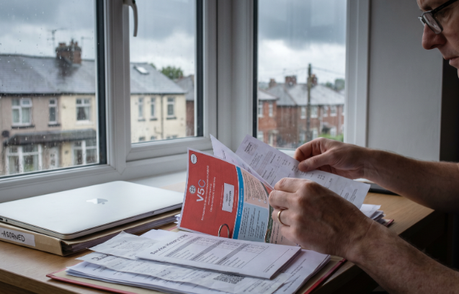
When it comes to paperwork for selling a car privately, nothing carries more weight than the V5C registration certificate — commonly known as the logbook. The V5C is the essential document for notifying the DVLA of a change in ownership. However, one critical point catches many sellers off guard: the V5C identifies the registered keeper, not necessarily the legal owner. Understanding that distinction matters, because a savvy buyer will know the difference and may question the paperwork accordingly.
Selling without a V5C is a risk most informed buyers in the North West simply won't accept. A missing logbook immediately raises concerns about whether the vehicle has been stolen or cloned — two red flags that can collapse a sale entirely, regardless of the car's condition or your asking price. In a competitive market stretching from Manchester to Preston, that stigma alone could cost you significantly. You should also confirm your logbook is the current multi-coloured version introduced in the mid-2000s; older green single-sheet versions are no longer valid for a standard private sale.
A missing V5C doesn't just reduce your asking price — it can eliminate your buyer pool altogether before negotiations even begin.
📋 Pro-Tip: Lost Your V5C? Here's What to Do
Apply for a replacement V5C directly through the DVLA using form V62, available at any Post Office or downloadable from GOV.UK. The replacement costs £25 and typically arrives within five working days. Applying well before you list your car avoids delays and demonstrates transparency to potential buyers — a small investment that protects your full asking price.
Service History: Turning Paper into Pounds
With your V5C logbook sorted, the next document that will genuinely move the needle on your asking price is the service history. This isn't just admin — it's a direct financial asset.
A complete Full Service History (FSH) can increase a vehicle's resale value by between 15% and 25%, according to Autochain. On a car listed at £8,000, that's potentially £2,000 sitting inside a folder in your glovebox. Few sellers realise quite how significant that gap is.
FSH vs. Partial History: The Price Reality
Buyers aren't just looking for stamps — they're looking for confidence. A full service history tells them the car was cared for consistently. Partial records leave doubt, and doubt becomes negotiating leverage against you. If you're missing a year or two, expect buyers to chip your price accordingly.
What North West Buyers Look For Specifically
Commuters across Greater Manchester, Merseyside, and Lancashire put serious miles on their vehicles. That makes certain receipts particularly persuasive:
- Timing belt and water pump replacements — critical for higher-mileage engines
- Brake pad and disc changes — reassures buyers about safety and running costs
- Tyre replacements — signals the car hasn't been run into the ground
These receipts, presented neatly, tell a story no test drive can match.
The 47% Rule: Don't Halve Your Buyer Pool
Research found that approximately 47% of used car buyers will not consider a vehicle without a full service history. That's nearly half the market gone before a single viewing.
When completing the sale, you'll hand over the V5C's green slip new keeper section alongside your service records. Presenting digital photos of receipts works, but a physical folder — organised chronologically — creates a psychological impression of care that screens simply can't replicate.
The MOT Certificate and Maintenance Trail
Beyond your service history, the supporting paper trail you hand over on sale day does quiet but powerful work. Think of it as evidence — and buyers in the North West are savvy enough to appreciate it.
Why the Paper MOT Still Matters
Technically, you don't need the physical MOT certificate to sell your car. The test result is publicly verifiable online, and any buyer can check it in seconds. However, having the original paper certificate adds an unmistakable layer of credibility. It signals you're an organised seller who keeps records — exactly the kind of person a cautious buyer wants to deal with.
Using MOT History to Prove Mileage Consistency
The government's free MOT history checker is one of the most underused tools in a private seller's arsenal. Each test records the mileage at the time of inspection, creating a chronological trail. If those figures rise steadily year on year, that's compelling proof your odometer reading is genuine — something a dealer's pitch rarely offers.
The Receipt Folder Trick
A physical folder of invoices, parts receipts, and garage bills transforms abstract claims about a car's condition into tangible proof a buyer can hold and review.
Compile every receipt you have — tyres, brakes, cambelt changes — into a single folder. Missing maintenance records can reduce a car's valuation by as much as 20% to 35%, so presenting this evidence proactively protects your asking price. Remember to notify the DVLA of the sold car promptly once you've agreed terms — but before that moment arrives, having that folder ready can be the difference between a buyer who haggles hard and one who pays your price without question.
Finalising the Sale: The Private Sales Receipt
With your service history and MOT paperwork assembled, the final step before handing over the keys is creating a clear, written record of the transaction itself. A private sales receipt costs nothing to produce but protects you considerably.
What Your Receipt Must Include
- Date of sale (DD/MM/YYYY format)
- Full sale price in £
- Vehicle Identification Number (VIN)
- Make, model, and registration
- Full names and addresses of both buyer and seller
- Signatures from both parties
The 'Sold as Seen' Clause
Include the phrase "sold as seen, tried, and approved without guarantee" on the receipt. This single line is your primary defence against post-sale complaints. A common pattern is for buyers to claim undisclosed faults weeks later — without this clause, your position is considerably weaker.
A properly worded 'sold as seen' receipt is one of the simplest yet most effective legal protections available to a private seller.
The Green Slip — Don't Drive Away Without Handing It Over
According to GOV.UK, the seller must provide the buyer with the V5C/2 — the green 'new keeper' supplement — as temporary proof of keepership. Tear this section from your V5C logbook and hand it directly to the buyer. It's their only official proof of ownership until the full V5C arrives in the post.
Post-Sale: Notifying the DVLA and Stopping Your Tax
The paperwork doesn't end when the buyer drives away. A few final administrative steps protect you from liability — and they're often overlooked entirely.
Complete these steps on the day you sell:
- Notify the DVLA online immediately. Use the GOV.UK vehicle sold notification service to register the change of keeper instantly. You'll need the buyer's name and address.
- Never rely on the buyer to post the V5C counterpart. As GOV.UK states, failure to notify the DVLA yourself can result in a fine and leave you liable for anything that happens with the vehicle afterwards.
- Claim your car tax refund. DVLA automatically cancels remaining tax and issues a cheque for any full months left — no separate application needed.
- Cancel your insurance. Ring your insurer the same day; cover on a vehicle you no longer own serves no purpose.
⚠️ Warning: Assuming the buyer will handle notification is a costly mistake — responsibility rests entirely with the seller.
Key Takeaways
Maximising your sale price in the North West comes down to preparation. Strong service history, a complete MOT trail, a watertight private sales receipt, and prompt DVLA notification combine to make you the most credible seller on the market. Handle the paperwork properly, and the price you're asking becomes much easier to justify.
Ready to sell your car? Get a free valuation at HPL Motors at your local car showroom across the North West.