/523/1/logo.png)
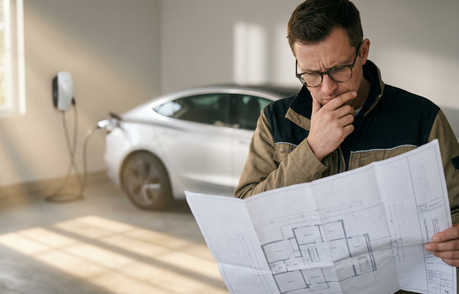
Home EV Charging: The Complete Guide for UK Electric Car Owners
Introduction to Home EV Charging
A thorough guide to EV charging installation to help you make an informed decision.
Home EV charging is the practice of charging an electric vehicle overnight using a dedicated wallbox charger installed at your property. It accounts for approximately 80% of all EV charging sessions in the UK, according to Zapmap's 2025 annual survey, making it the most common and cost-effective way to keep an electric vehicle charged.
Rather than weekly trips to a petrol station or planning routes around public chargers, most EV owners simply plug in when they get home and wake up to a full charge. With over 1.83 million pure-electric cars now on UK roads — and 23% of all new cars sold in 2025 being fully electric — understanding how home charging works is essential knowledge for any driver considering the switch.
For those considering Tesla charging at home or any other EV brand, the setup is more straightforward than many expect.
- A dedicated home wallbox charger typically delivers 7kW of power, enough to add around 30 miles of range per hour.
- An overnight charge of 8–10 hours comfortably replenishes most daily driving.
- Government grants are available in certain circumstances, and installation is typically completed within a few hours.
This guide covers everything you need to know: how home charging works, what to consider when installing a charger, the 80% battery rule, smart charging, and the specific options available for Tesla owners.
Understanding the 80% Rule for EV Charging
The 80% rule for EV charging is the manufacturer-recommended practice of setting your battery's charge limit to 80% rather than 100% during regular daily use, in order to preserve long-term battery health.
The reason comes down to lithium-ion battery chemistry. Charging to maximum capacity creates additional stress on battery cells, particularly when the vehicle sits at 100% for extended periods. Regularly charging to lower levels reduces degradation rates over the vehicle's lifetime — most major manufacturers, including Tesla, Volkswagen, and Nissan, build this recommendation into their charging guidance. In practice, the 80% limit is rarely a constraint. Most UK drivers cover fewer than 40 miles daily, well within the range available even at a reduced charge level. Modern smart chargers and EV companion apps allow you to set your charge limit directly, so the car stops automatically at your chosen threshold.
The exception is long journeys requiring maximum range. Charging to 100% the night before an extended trip causes minimal harm — what matters is avoiding the habit of consistently maintaining the battery at full capacity, particularly when the car is parked for days at a time.
How Home Charging Works
A home EV charger works by drawing electricity from your domestic supply through a dedicated charging unit, which then delivers power to your vehicle's battery at a controlled, safe rate.
The process begins when you plug in your EV, triggering a communication protocol between the car and charger. This determines the appropriate charging rate based on your battery's current state, temperature, and capacity. Most home EV charging installations in the UK use a 7kW wallbox charger connected to a 240V supply — the same voltage as your oven or electric shower — delivering roughly 25–30 miles of range per hour.
A Battery Management System (BMS) is the onboard computer that regulates cell voltage, temperature, and charging rate throughout the process. The BMS communicates with your charger in real time, ensuring power delivery stays within safe limits. This is why you can leave your EV plugged in overnight without concern — the system stops drawing power automatically once the target charge level is reached.
For those considering electric vehicle warranties, professional installation ensures these systems operate correctly within your home's electrical infrastructure. A dedicated home wallbox differs significantly from using a standard three-pin socket — it is hardwired into your consumer unit with appropriate circuit protection, designed specifically for daily EV charging use.
Considerations for Installing a Home EV Charger
Installing a home EV charger requires:
- assessing your property's electrical capacity
- choosing an appropriate charger type
- using an OZEV-approved installer (which is also required to access any available government grants).
Most homes in the UK operate on a single-phase 230V supply, typically delivering between 60–100 amps. A 7kW home charger draws approximately 30 amps. An electrician will need to assess whether your existing consumer unit (fuse box) has sufficient spare capacity alongside your everyday appliances, or whether an upgrade is required. For most modern UK properties, this is a straightforward assessment rather than a major concern.
Physical location matters considerably. Chargers should be positioned to minimise cable run distance to your regular parking spot, ideally within two metres. If you're charging outside, the unit will need an appropriate IP rating for weather resistance. Wall-mounted units work well for most properties; floor-standing bollards suit homes without suitable wall surfaces.
Government grant support is currently available for certain installations. The OZEV EV Chargepoint Grant provides up to £350 (rising to £500 from April 2026) for renters and flat owners with dedicated off-street parking. Note that this grant is no longer available to standard homeowners who own a house — the scheme now specifically supports flat owners and renters. All installations must be carried out by an OZEV-approved installer.
Smart chargers — those with Wi-Fi connectivity — are increasingly the standard choice, enabling scheduled charging during off-peak electricity tariff hours, remote monitoring via smartphone app, and compatibility with specialist EV tariffs such as Octopus Go or OVO Drive Anytime. Scheduling your charging to run overnight during off-peak hours can significantly reduce the cost per charge.
Thinking about buying an electric car?
HPL Motors stocks over 80 used Teslas plus a wide range of used EVs from Nissan, Hyundai, Kia, Volkswagen and more.
👉 Browse our used electric cars across Manchester, Lancashire & Merseyside
Detailed Look: Tesla Charging at Home
Tesla charging at home works via the Tesla Wall Connector, a proprietary home charger that delivers up to 11.5kW — significantly faster than the standard 7kW wallbox, and integrates directly with Tesla's vehicle software and app.
Tesla Wall Connector vs Universal Chargers
The Tesla Wall Connector is designed specifically for Tesla vehicles but Tesla owners are not limited to branded equipment. Third-party 7kW wallbox chargers work with Tesla vehicles using the included Type 2 adapter (Tesla switched from a proprietary connector to the standard CCS/Type 2 charging standard in 2022, making compatibility straightforward). According to Zapmap's charging statistics, the continued expansion of universal charging infrastructure means Tesla drivers have more flexibility than ever when selecting home charging equipment.
Smart Features and Tesla Integration
What distinguishes Tesla's home charging is the depth of software integration. The Tesla app automatically schedules charging during off-peak electricity hours, tracks energy consumption, and can adjust the charging rate based on your set departure time. This makes the Wall Connector more than a power delivery unit — it functions as part of Tesla's broader energy management ecosystem.
That said, a quality third-party smart charger from brands such as Pod Point, Ohme, or Hypervolt delivers comparable scheduling, off-peak functionality for non-Tesla EVs, and can be a cost-effective alternative if you anticipate changing vehicles in future.
HPL Motors currently has over 80 used Teslas in stock.
From Model 3 to Model Y, find your perfect used Tesla with flexible finance options.
👉 View our second-hand Tesla stock
Common Misconceptions About Home EV Charging
Several persistent myths about home EV charging deter potential EV owners or lead to poor charging habits. Here's what the evidence actually shows.
"Home charging takes all night"
Overnight charging is convenient, but rarely a necessity dictated by charging speed. Most UK drivers use 30–40 miles of range daily, which a 7kW charger replenishes in roughly two hours. The typical overnight session simply ensures a full battery each morning — it's a matter of habit and convenience, not a technical constraint.
"You need expensive electrical upgrades"
Most modern UK properties can accommodate a standard 7kW charger with minimal electrical work. A professional survey will confirm your specific requirements — wholesale consumer unit replacements are the exception rather than the rule. Installation costs typically range from £800–£1,200 including the charger unit, according to Checkatrade data.
"Public charging is just as convenient"
Around 80% of EV charging in the UK happens at home — not because public charging is unavailable, but because home charging is faster to access, cheaper per kWh, and eliminates queuing. Public rapid chargers average 76p per kWh vs the significantly lower overnight home rate, according to Uswitch's 2025 EV charging analysis.
"Level 2 charging is an American term — what does it mean in the UK?"
The term "Level 2 charger" originates from North American charging classifications. In the UK, this simply refers to a standard 7kW home wallbox charger — the type installed by most EV owners. It connects to a 240V supply and is distinct both from a slow three-pin socket (2.3kW) and from rapid public chargers (50kW+).
Home EV Charging in Practice: Real Costs and Scenarios
Home charging is significantly cheaper than public charging or petrol. According to Uswitch's 2025 analysis, EV drivers who charge at home 80% of the time typically pay around £630 per year to run their car — less than half the £1,410 average annual petrol cost for an equivalent vehicle. That equates to roughly 6p per mile, compared to around 14–18p per mile for petrol.
A full charge at home — based on a typical 54kWh battery and average domestic electricity rate — costs approximately £13, according to Pod Point's October 2024 data. On a dedicated EV electricity tariff with overnight off-peak rates (such as Octopus Go), this figure can drop considerably further.
For a family covering 40 miles daily in the North West, a 7kW home wallbox will typically replenish that range in under two hours. Plugging in at 10pm and scheduling to charge overnight on an off-peak tariff means the car is ready by morning at the lowest possible cost per mile.
For drivers in flats or terraced houses without driveways, the picture is more complex. On-street public charging availability varies by area — the North West currently has lower on-street charging provision than London, according to Zapmap's 2024 regional analysis. This is worth factoring in when deciding whether a home charger is viable for your property type.
Limitations and Considerations of Home EV Charging
Home charging is not a universal solution, and understanding its limitations before purchase avoids disappointment.
Property and access constraints are the most common barriers. Renters need landlord permission; flat owners in leasehold properties may need freeholder consent. Even for homeowners, properties where the parking space is far from the consumer unit may require longer cable runs, adding to installation cost. Homes with no off-street parking will need to rely on public charging infrastructure or on-street solutions.
Charging speed limitations become relevant for high-mileage drivers. A 7kW home charger adds roughly 30 miles per hour — adequate for typical daily patterns but insufficient for drivers covering 150+ miles daily who need to recharge between shifts.
Cold weather reduces charging efficiency by approximately 10–20%, and also reduces the available range from a given charge. This is worth factoring into winter planning, particularly for drivers who rely on a fixed daily range.
Grant eligibility has changed. The original homeowner OZEV grant has ended. The current OZEV EV Chargepoint Grant (up to £350, rising to £500 from April 2026) is now specifically for renters and flat owners with dedicated off-street parking. Standard homeowners are no longer eligible, though the installation cost without a grant remains competitive against the long-term fuel savings.
Key Takeaways
Home EV charging is the most practical, cost-effective solution for the majority of electric vehicle owners in the UK. Around 80% of EV charging sessions in the UK happen at home, and drivers who charge primarily at home pay on average less than half the annual fuel cost of a comparable petrol car.
The fundamentals are straightforward: a 7kW wallbox charger installed by an OZEV-approved electrician, scheduled to charge overnight on an off-peak tariff, and set to an 80% daily charge limit will cover almost all everyday driving needs efficiently and cheaply.
What varies is the setup: your property type, proximity to the consumer unit, vehicle model, and daily mileage all affect which solution is right for you. For Tesla owners, the Wall Connector offers deeper software integration; for all other EVs, a quality third-party smart charger delivers comparable functionality.
If you're considering buying an electric car and want to understand the total ownership picture — including charging — the team at HPL Motors can talk you through what to expect before you commit.
Ready to make the switch to electric?
Browse over 1,500 quality used cars at HPL Motors — including EVs, PHEVs, and hybrids — with flexible finance across our five North West dealerships.
👉 Search used electric cars at HPL Motors
Frequently Asked Questions
How long does a full charge take at home?
A standard 7kW home wallbox charger fully charges most EVs in 8–10 hours overnight, making it ideal for daily use. A 50kWh battery, for example, charges from near-empty to full in around 7–8 hours. Faster 22kW chargers can reduce this to 3–4 hours, though installation costs are higher and not all vehicles support 22kW AC charging. A typical 30-mile daily commute requires only around 2 hours of charging at 7kW.
Can I charge an EV from a standard plug socket?
A standard three-pin socket delivers only 2.3kW and should be treated as a temporary or emergency option only. Extended use risks overheating the circuit unless it has been checked by a qualified electrician. A dedicated wallbox is faster, safer, and designed specifically for regular daily charging — most EV manufacturers supply an emergency three-pin cable for occasional use but recommend a wallbox for home installation.
What if I don't have off-street parking?
Home charging requires dedicated parking with access to your property's electricity supply. Without a driveway or garage, you'll typically need to rely on public charging networks or workplace facilities. Some UK local councils are installing on-street charge points, though Zapmap's regional data shows that provision outside London remains limited — the North West, in particular, has lower on-street charging availability than southern regions, though this is improving.
Will home charging increase my electricity bill substantially?
Home charging adds considerably less to your energy bill than petrol costs per mile. According to Uswitch's 2025 EV charging analysis, a typical EV covering 10,000 miles annually adds roughly £300–£500 to electricity bills on standard tariffs — and less on dedicated EV off-peak tariffs. This compares favourably to petrol costs of £1,400+ for the same mileage.
Do I need permission to install a home charger?
Most home EV charger installations in the UK do not require planning permission, though listed buildings and conservation areas may have restrictions. Renters must obtain landlord permission; leasehold flat owners may need freeholder consent. The OZEV grant guidance on GOV.UK provides full eligibility criteria for grant-supported installations.
Is the OZEV home charger grant still available?
The OZEV EV Chargepoint Grant is still available, but its scope has changed. The original homeowner grant has ended. The current scheme — extended until 31 March 2027 via GOV.UK — provides up to £350 (rising to £500 from April 2026) for renters and flat owners with dedicated off-street parking. Standard homeowners are no longer eligible. All installations must be completed by an OZEV-approved installer.
What is the best home EV charger for a Tesla?
The Tesla Wall Connector is the manufacturer's recommended home charger, delivering up to 11.5kW and offering deep integration with the Tesla app. However, any 7kW Type 2 wallbox charger is compatible with Tesla vehicles using the included adapter — brands such as Pod Point, Ohme, Hypervolt are widely used by Tesla owners in the UK, and offer comparable smart charging functionality. The right choice depends on whether you prioritise Tesla ecosystem integration or flexibility for future vehicles.