/523/1/logo.png)
How to Check Your Car Tyres: Tread, Pressure & When to Replace
How to Check Your Car Tyre Tread and Pressure — UK Guide
Your tyres are the only part of your car that touches the road, yet they’re one of the most overlooked safety items on any vehicle. Checking tyre tread and pressure takes less than five minutes and requires no mechanical expertise — but it could be the difference between stopping safely and a serious accident.
This guide explains exactly how to check your car tyre tread depth and pressure at home using the 20p coin test, a tread depth gauge, and a tyre pressure gauge. We’ll also cover when tyres need replacing and what warning signs to look out for — including a section on run-flat tyres.
Book your tyre check at HPL Motors →
How to Check Tyre Tread Depth
UK law requires a minimum tread depth of 1.6mm, but most safety experts — and our technicians at HPL Motors — recommend replacing tyres at 3mm. Below 3mm, wet-weather stopping distances increase significantly. If you want to leave it to the experts, we’ll be happy to help, but here’s how to check at home.
Method 1: The 20p Coin Test
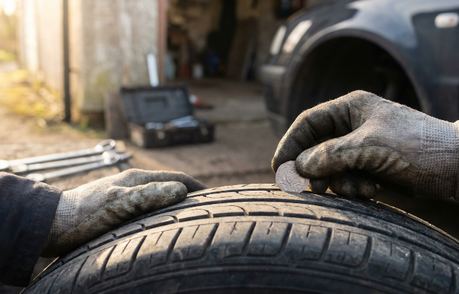
The quickest way to check your tyre tread depth is the 20p coin test. The outer band of a 20p coin measures approximately 1.6mm — exactly the legal UK minimum.
- Take a 20p coin and insert it into the main tread grooves of your tyre.
- If the outer band of the coin is visible above the tread surface, your tyres are at or below the legal limit and must be replaced immediately.
- Check at least three points across the width of each tyre (inner edge, centre, and outer edge) — tyres often wear unevenly.
- Repeat at multiple points around the circumference of each tyre.
Method 2: Tread Wear Indicators (TWIs)
Every modern tyre has built-in tread wear indicators — small rubber bars moulded into the tread grooves at exactly 1.6mm height. Look for the letters “TWI” or a small triangle on the tyre sidewall; these mark the location of each indicator bar.
When the tread surface wears flush with these bars, your tyre has reached the legal minimum and must be replaced. If you’re close to the indicator level but not quite there, start planning your replacement — you’re already below the 3mm safety recommendation.
Method 3: Digital Tread Depth Gauge
For a precise reading, a digital tread depth gauge (available from most motoring retailers for under £10) gives millimetre-accurate measurements. Press the probe into the main tread groove and check at least three points across the width of each tyre, and at multiple positions around the circumference.
- Readings of 3mm or below: plan tyre replacement soon
- Readings at or below 1.6mm: replace immediately — this is the UK legal limit
- Uneven wear patterns (e.g. one edge wearing faster) may indicate a wheel alignment or suspension issue
How to Check and Set Tyre Pressure
Tyre pressure affects everything: fuel efficiency, handling, tyre wear, and safety. An under-inflated tyre generates excess heat, wears faster, and reduces your ability to brake and corner. Over-inflation creates a harsh ride and uneven wear in the centre of the tread.
Step 1: Find Your Recommended Tyre Pressure
Your vehicle’s recommended tyre pressures are specific to that model — do not use the maximum pressure stamped on the tyre sidewall, as that’s the absolute ceiling, not the target operating pressure.
Find your recommended pressures in one of these places:
- The sticker inside your driver’s door jamb (most common)
- Your owner’s handbook
- Sometimes on the fuel filler cap
Most cars require between 30–35 PSI, though heavier vehicles or fully loaded cars may need higher rear pressures. Note down both front and rear figures before you start.
Step 2: Check Pressure When Tyres Are Cold
Always check tyre pressure when tyres are cold — meaning the vehicle hasn’t been driven for at least three hours, or has covered less than two miles. Driving heats up air inside the tyres, which increases pressure readings by 4–6 PSI. Checking warm tyres will give a falsely high reading and could lead to under-inflation.
Step 3: Take the Reading
- Remove the dust cap from the tyre valve stem and keep it somewhere safe.
- Press your digital tyre pressure gauge firmly onto the valve stem until the hissing stops.
- Read the display and compare against your vehicle’s recommended PSI.
- Take two readings per tyre to confirm accuracy — variations of more than 1–2 PSI suggest an imperfect seal.
- Replace the dust cap immediately.
Step 4: Adjust if Needed
If pressure is too low, use an air compressor (available at most petrol stations) to add air in short bursts, rechecking frequently. If you’ve over-inflated, press the small metal pin inside the valve stem to release air gradually — check as you go.
How Often Should You Check Tyre Pressure and Tread?
How long your tyres will last can change significantly depending on multiple factors, including mileage and tyre type. Consumer Reports states that recent tests showed high-scoring all-season tyres will last between 55,000-95,0000 typically. And Bridgestone's tyre lifespan guidance estimates that on average tyres should last between 3-5 years.
Tip: Industry experts recommend replacement after six years even if the tread appears adequate.
As a general rule:
- Tyre pressure: check monthly, and always before a long motorway journey
- Tread depth: check every two months, or after any kerb strike or suspected impact
- Seasonal change: tyres lose approximately 1–2 PSI for every 10°C drop in temperature, so autumn and winter warrant closer monitoring
A common mistake is relying on annual servicing alone. Six months between checks is too long — slow punctures, gradual pressure loss, and uneven wear can develop quickly and go unnoticed until they’ve become a safety risk or an MOT failure.
Tip: According to USTMA tire care guidance, proper valve maintenance is often overlooked yet essential for maintaining tyre pressure integrity between checks.
When Should I Replace My Car Tyres?
Tread depth is the most obvious indicator, but it’s not the only one. Here’s what to look for:
Tread Depth
- Replace at 3mm for optimal safety in wet conditions — don’t wait for the legal 1.6mm limit
- At 1.6mm, stopping distances in the wet are dramatically longer than at 3mm
Visible Damage
- Sidewall bulges or cracks: these indicate internal structural failure and are a blowout risk at speed — replace immediately
- Cuts or deep gouges: any cut longer than 6mm or deeper than the tread should be inspected by a professional
- Exposed cords or fabric: the tyre has been worn well beyond safe limits
Age
Rubber compounds degrade over time regardless of mileage. Even a tyre with plenty of tread can become unsafe as it ages and the rubber hardens and develops microscopic cracks.
- Most manufacturers recommend replacing tyres after six years
- At ten years, tyres should be replaced regardless of appearance
- To find your tyre’s age, look for the four-digit DOT code on the sidewall — the first two digits are the week, the last two are the year (e.g. “2319” = 23rd week of 2019)
Vibration and Handling
- Persistent vibration that increases with speed, even after balancing, may indicate internal belt separation
- If the car pulls to one side or the steering wheel shakes at motorway speeds, book an inspection — don’t wait for visual confirmation
Run-Flat Tyres — What You Need to Know
Run-flat tyres (RFTs) are designed to remain driveable after a puncture, allowing you to continue at reduced speed (typically up to 50 mph) for a limited distance (usually around 50 miles). They’re increasingly common on newer vehicles, particularly BMWs, Minis, and some Mercedes models.
Key differences from standard tyres:
- Run-flats have reinforced sidewalls that support the vehicle’s weight even when deflated, meaning you may not notice a puncture without a TPMS warning
- They should not be repaired after a puncture in most cases — the internal structure may be compromised even if the tyre looks undamaged
- Run-flats are typically more expensive to replace than standard tyres
- Not all garages stock run-flat sizes — if you drive on run-flats, it’s worth knowing which size you need before you need it urgently
Can you replace run-flat tyres with standard tyres?
In most cases, yes — but only if your vehicle has a TPMS system (which is a legal requirement for cars registered after November 2014 in the UK), and you’re willing to carry a spare or tyre repair kit. Check your owner’s handbook or speak to our team at HPL Motors before switching, as some vehicles have no wheel arch space to accommodate a spare.
Common Tyre Check Mistakes to Avoid
- Checking pressure when tyres are warm — always check cold for an accurate reading
- Only checking the front tyres — rear tyre blowouts are harder to control and equally dangerous
- Using the pressure on the tyre sidewall as your target — that’s the maximum, not the recommended pressure
- Waiting until the legal 1.6mm limit to replace — 3mm is the safety threshold for wet-weather performance
- Ignoring age — a visually fine tyre can be structurally compromised after six or more years
Where to Look Next: Finding Credible Sources
Stay informed beyond this guide by bookmarking authoritative resources that update as tyre technology evolves. The U.S. Tire Manufacturers Association provides comprehensive maintenance guidelines, whilst the NHTSA's TireWise programme offers safety ratings, and recall information—both essential for proactive tyre management. For manufacturer-specific guidance, Bridgestone's maintenance hub and Cooper Tire's educational resources explain how design differences impact longevity. Fleet managers seeking scalable solutions should explore Fleetio's tire management practices, which translate equally well to household vehicle tracking.
The most powerful resource? Your vehicle's handbook—it contains pressure specifications and rotation schedules tailored to your exact model. Combine these trusted sources with monthly hands-on checks, and you'll master tyre care that protects both passengers and budget for years ahead.
Frequently Asked Questions
Get a Free Tyre Check at HPL Motors
If you’re unsure about the condition of your tyres — or you’ve noticed any of the warning signs in this guide — our qualified technicians are here to help. We carry out free visual tyre checks at our service centre, giving you an honest assessment of tread depth, pressure, wear patterns, and tyre age.
We stock a wide range of replacement tyres across all budgets, and we’ll only recommend replacement when it’s genuinely needed. No upselling, no pressure.